Market District
A shared game state
A private, synchronous 3–5 player negotiation board game for remote game nights, built as an unofficial non-commercial web adaptation inspired by Chinatown.
Solo full-stack developer and game systems designer
Delivered a complete six-round multiplayer flow and validated it through a five-player UAT that reached final scoring. Four feedback-driven interface and rule-clarity fixes were implemented and retested. Shared privately through temporary Cloudflare Quick Tunnels rather than a permanent public deployment.
01 / 03 A private, synchronous 3–5 player negotiation board game for remote game nights, built as an unofficial non-commercial web adaptation inspired by Chinatown.
The problem to solve.
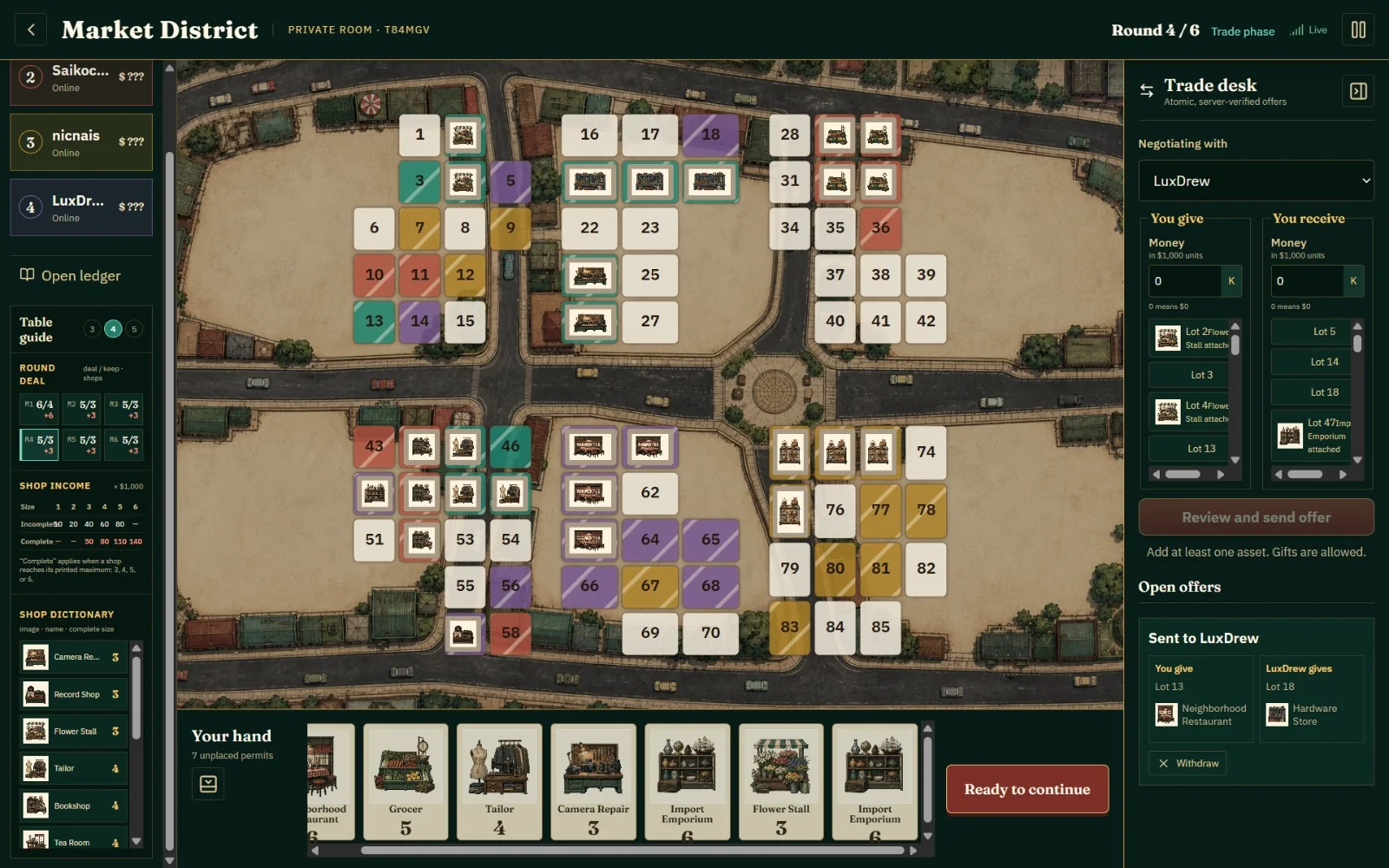
Market District is a private, synchronous negotiation board game for 3–5 players. It recreates the social tension of trading properties, money, and shop permits across a shared district while moving hidden information and rule enforcement into a server-authoritative online experience. It is an unofficial, non-commercial project with original branding, writing, board art, and shop art.
Problem
Physical negotiation board games are difficult to play across different homes because their hidden information, simultaneous deals, shared board state, and turn transitions do not translate cleanly to a video call.
People
Small groups of friends playing private online board-game sessions
The choices behind the interface.
Designed the original product identity and responsive game table, implemented the six-round rules engine, built private-room multiplayer and atomic trade flows, and connected the React client to a stateful Cloudflare Worker backend.
Designed for private game nights rather than public commercial distribution. The current hosted flow uses temporary Cloudflare Quick Tunnels, so no unstable tunnel URL is presented as a permanent live demo.
- Preserving hidden information while keeping every browser synchronized to one authoritative match
- Making multi-asset trades atomic so money, lots, and shop tiles cannot partially transfer
- Translating a dense physical board and reference tables into a readable responsive interface
- Handling reconnects, duplicate commands, stale versions, and host controls without desynchronizing the room
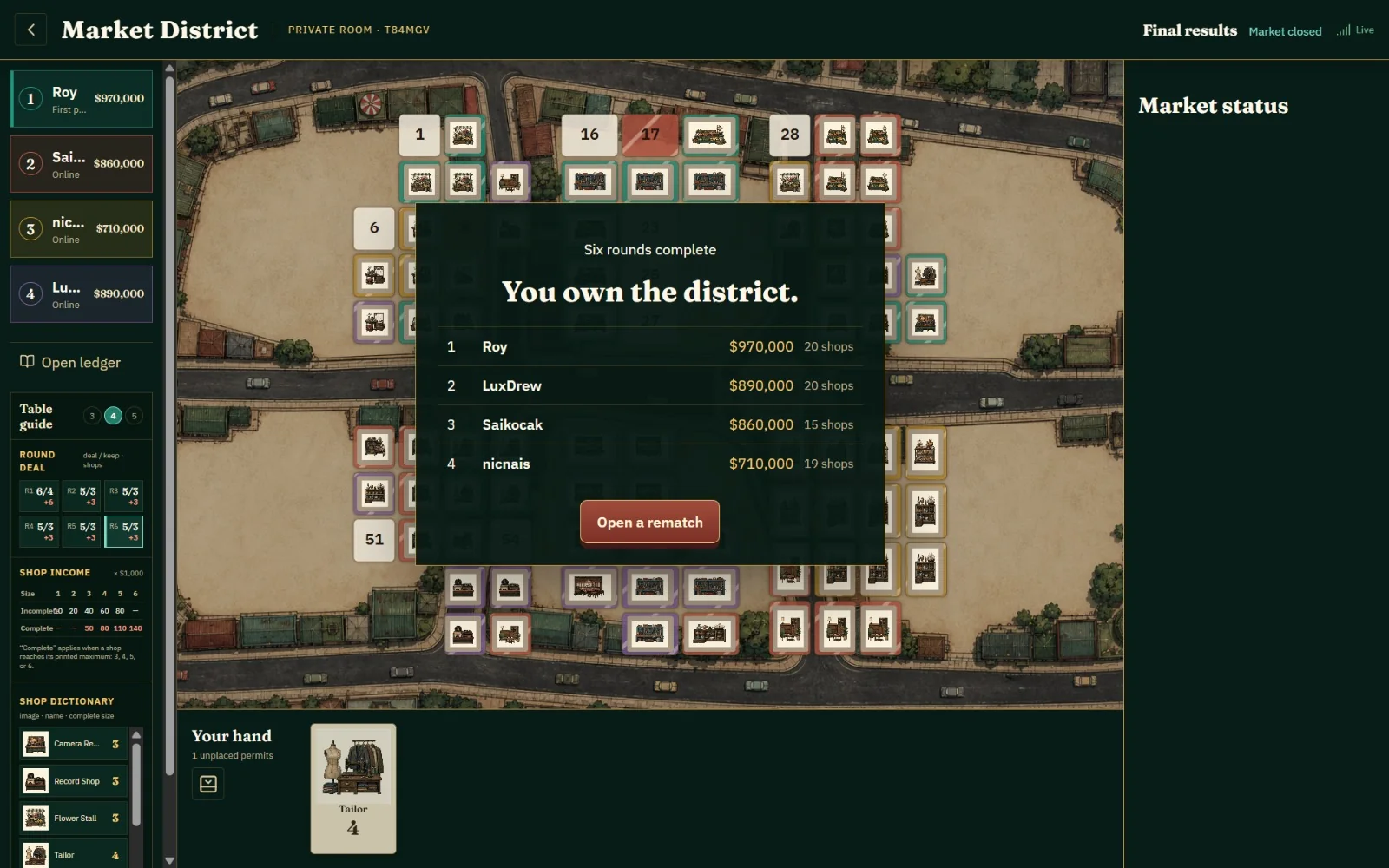
What I built.
Designed the original product identity and responsive game table, implemented the six-round rules engine, built private-room multiplayer and atomic trade flows, and connected the React client to a stateful Cloudflare Worker backend.
The monorepo separates the React/Vite client, shared game engine, validated protocol, reusable UI, and Cloudflare Worker. Each room is owned by one SQLite-backed Durable Object; clients send versioned commands over WebSockets and receive a player-specific projection of the authoritative state.
- Modeled the complete six-round game loop as a reusable TypeScript engine covering property selection, trading, placement, income, pause/resume, and final scoring.
- Built password-protected rooms, signed player sessions, reconnectable WebSocket state, per-player hidden views, and host-only room controls on Cloudflare Workers and Durable Objects.
- Designed the dense desktop game table, responsive player drawers, ledger, shop reference, board interactions, trade desk, and final-results experience.
System architecture +
React/Vite client → Zod-validated command protocol → Cloudflare Worker routing → one Durable Object and SQLite state store per room → player-specific WebSocket snapshots.
Results, with context.
Delivered a complete six-round multiplayer flow and validated it through a five-player UAT that reached final scoring. Four feedback-driven interface and rule-clarity fixes were implemented and retested. Shared privately through temporary Cloudflare Quick Tunnels rather than a permanent public deployment.
Completed a playable end-to-end match flow with original visual assets, automated engine and security tests, and browser-level coverage. A five-player UAT completed all six rounds, then retested fixes for currency input and shop-income clarity, lot and tile hover labels, thinner selection indicators, and the shop dictionary.
UAT players
Rounds completed
Feedback fixes retested
Lessons & next steps +
- Multiplayer game UI must expose server state clearly without leaking private player information
- A pure rules engine makes complex turn transitions easier to test than logic embedded in React components
- Multiplayer playtesting exposed rule and visual-discoverability gaps that automated coverage could not reveal
- Temporary tunnels are useful for private validation but should not be represented as durable production hosting
Under the hood.
Technologies & features +
React / TypeScript / Vite / Cloudflare Workers / Durable Objects / WebSockets / SQLite / Zod / Vitest / Playwright
- Private password-protected rooms for 3–5 players
- Real-time WebSocket synchronization and reconnectable sessions
- Server-authoritative six-round game engine
- Hidden property and shop hands projected per player
- Atomic money, property, and shop-tile trade offers
- Interactive district board with shop placement and ownership states
- Automatic shop income, ledger history, and final ranking
- Site access gate and host-only pause, resume, and room controls