SAKTI — ML-Assisted Tailor Allocation & Cooperative Management System
Allocation with context
A data-driven decision-support platform designed to improve workload allocation, inventory visibility, and operational coordination for a tailor cooperative.
ML workflow, allocation logic, full-stack development, data visualization, and presentation
2nd Place — PCU × SUTD GEO 2026; functional prototype presented with Koperasi Sumber Mulia Barokah as the industry partner.
01 / 05 A data-driven decision-support platform designed to improve workload allocation, inventory visibility, and operational coordination for a tailor cooperative.
The problem to solve.
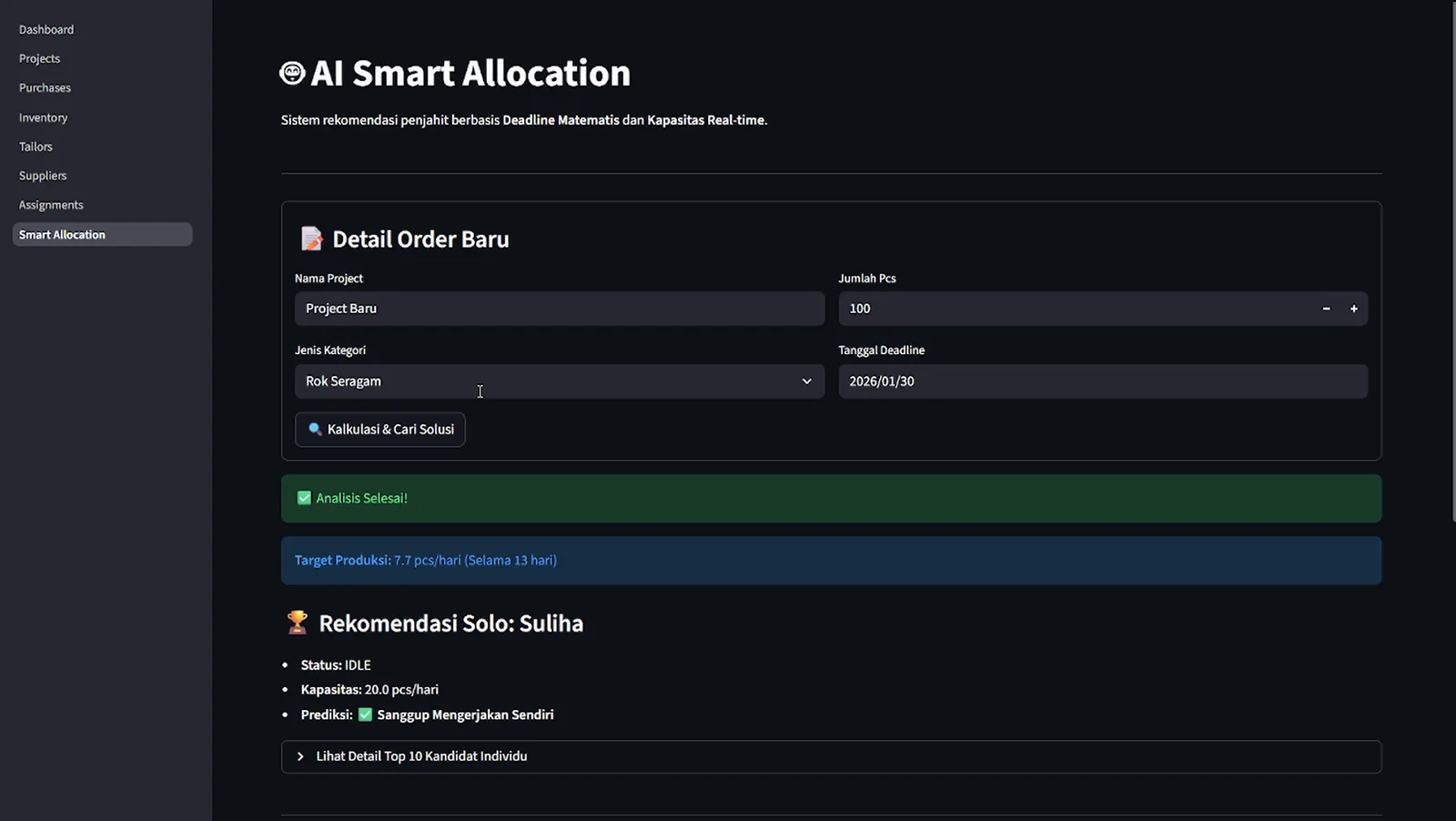
SAKTI is an ML-assisted tailor allocation and cooperative management platform developed during GEO 2026, a collaborative program between Petra Christian University and the Singapore University of Technology and Design. Created with Koperasi Sumber Mulia Barokah, the functional prototype combines tailor profiling, context-aware recommendation logic, live workload checks, inventory management, project tracking, purchasing, production monitoring, wages, and operational analytics.
Problem
Administrators distributed orders across a large tailor network using memory, personal familiarity, and manual communication, creating uneven workloads, limited inventory visibility, and pressure during bulk orders.
People
Cooperative administrators and managers; member tailors are the primary beneficiaries
The choices behind the interface.
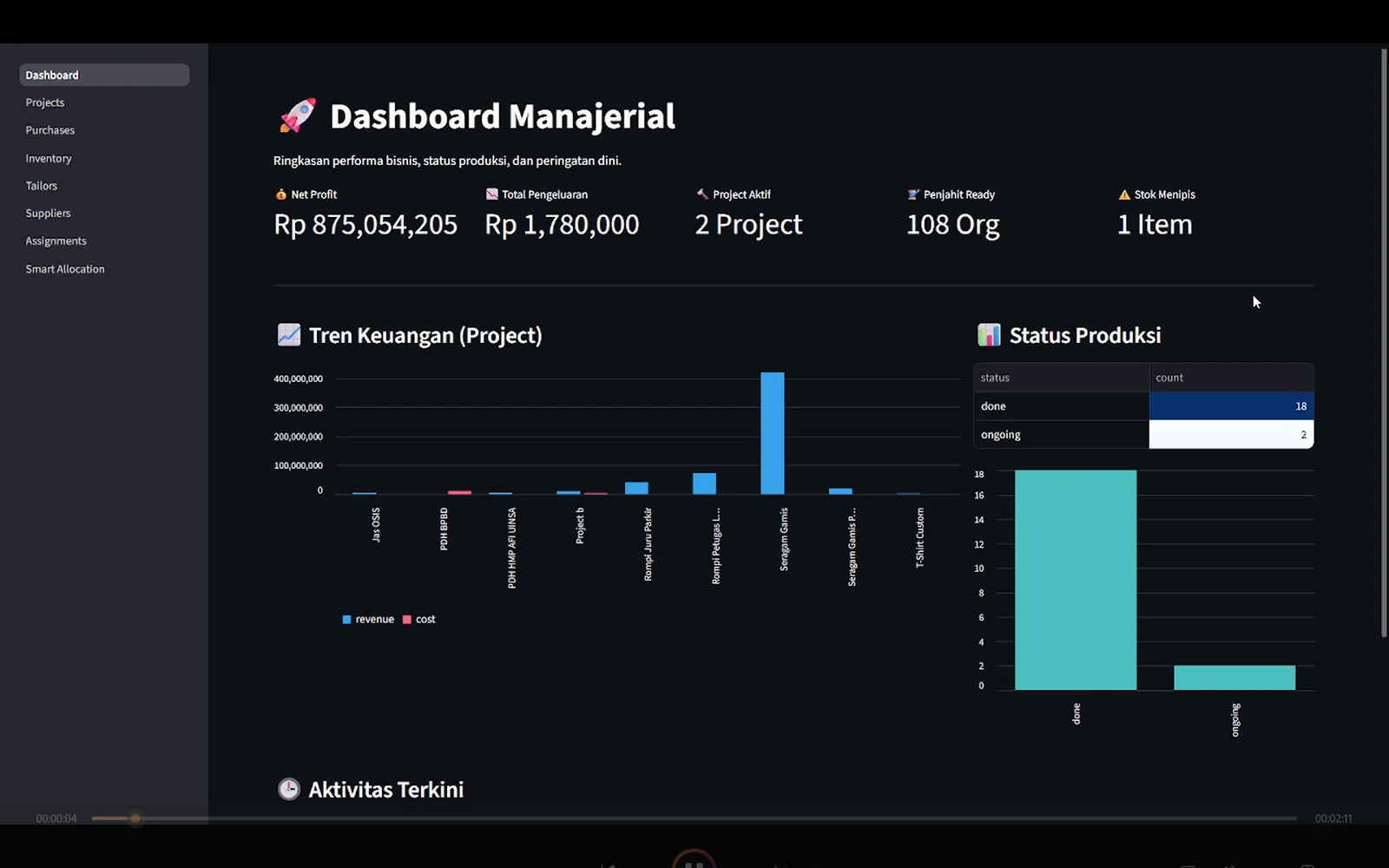
Translated the operational problem into a functional decision-support prototype spanning ML-assisted profiling, adaptive allocation logic, integrated operational data, Streamlit interfaces, and visual analytics.
- Cleaning and structuring cooperative tailor data before feature engineering
- Integrating clustering output into practical work-allocation workflows
- Coordinating across multidisciplinary team members (Business, Architecture, International Business)
Product discovery & user context +
Product discovery
From operational friction to a product decision
Problem framing
How might we distribute each project across available tailors so the cooperative can improve production efficiency while responding to order urgency and quantity?
Hypothesis
If the system combines historical performance profiles with order context and current workload, admins can move from memory-based assignment toward faster, fairer, and more explainable decisions.
Primary persona
Primary User
Cooperative Operations Administrator Responsible for incoming orders, tailor allocation, inventory visibility, production monitoring, and deadline coordination across a large partner network.Pain points
- Unfair workload distribution and bottlenecks around favorite tailors
- Difficulty remembering individual speed, neatness, and availability
- No integrated view of active work and leftover material
- Missed deadlines and high manual coordination overhead
Goals
- Efficient and fair allocation
- Data-driven decision support
- Real-time production and inventory visibility
- Less manual managerial work
Customer journey & product response
- 01
Receive a bulk order
Friction: The admin accepts a high-volume request without an immediate capacity view.
Product response: Capture category, quantity, and deadline as structured allocation inputs.
- 02
Check material readiness
Friction: Leftover fabric is tracked manually and may become ghost inventory.
Product response: Surface stock, purchases, and material requirements in the same management system.
- 03
Distribute the workload
Friction: The admin must remember who is fast, neat, nearby, and currently free.
Product response: Rank tailors through profiling, context-aware weights, logistics rules, and live status.
- 04
Track production
Friction: Active jobs and deadlines are scattered across messages and manual notes.
Product response: Connect assignments to progress, status, and operational dashboards.
- 05
Close and recycle capacity
Friction: Finished work and leftover material are difficult to reconcile for the next order.
Product response: Return completed tailors to the available pool and update remaining stock.
Value Proposition Canvas
Customer profile
Jobs
- Manage bulk orders
- Control inventory
- Distribute workloads
- Monitor progress
Pain points
- Human-memory dependency
- Uneven assignments
- Ghost inventory
- Production bottlenecks
Gains
- Fair allocation
- Faster decisions
- Visible capacity
- Managerial automation
Value map
Products & services
- Smart Tailor Allocation System
- Integrated cooperative dashboard
Pain relievers
- ML-based tailor profiling
- Live workload checks
- Inventory and progress records
Gain creators
- Specialization-aware matching
- Adaptive scoring
- System-driven operations
Business Model Canvas
Customer segments
- Tailor cooperatives
- Cooperative admins and managers
- Member tailors
- Bulk uniform buyers
Value propositions
- Fair workload distribution
- Deadline-adaptive recommendations
- Integrated production and stock visibility
Key resources
- Curated tailor profiles
- Allocation logic
- Python, Streamlit, SQLite, and scikit-learn
Key activities
- Tailor profiling
- Algorithmic assignment
- Inventory tracking
- Production and wage monitoring
Partners & channels
- Fabric suppliers
- Tailor communities
- Institutions placing bulk orders
- Web-based office dashboard
Cost structure
- Hosting and maintenance
- Tailor skill-data updates
- Operational inventory data entry
What I built.
Translated the operational problem into a functional decision-support prototype spanning ML-assisted profiling, adaptive allocation logic, integrated operational data, Streamlit interfaces, and visual analytics.
- Prepared and processed tailor performance data for the ML-assisted profiling workflow.
- Developed the adaptive allocation and workload-balancing logic, then integrated recommendations with operational project data.
- Built prototype interfaces and operational visualizations using Python and Streamlit.
- Created the persona, journey map, storyboard, Value Proposition Canvas, and Business Model Canvas that shaped the product direction.
- Translated the technical logic into a business-oriented presentation and defended the solution during final evaluation.
Explore the pipeline
01Layer 1 - Smart profiling: clean historical data and cluster tailors by speed, neatness, punctuality, distance, specialty, and related performance patterns.
Tailor history produces reusable profiles; the current order adds urgency, quantity, category, and logistics context; live assignment data then adjusts the final ranking shown in the cooperative dashboard.
02Layer 2 - Adaptive scoring: translate category, quantity, and deadline into changing weights; urgent work emphasizes speed, while relaxed work gives neatness more influence.
Layer 2 - Adaptive scoring: translate category, quantity, and deadline into changing weights; urgent work emphasizes speed, while relaxed work gives neatness more influence.
03Layer 2 - Logistics context: favor nearby tailors for small jobs and accept more distance for large-volume work where transport can be consolidated.
Layer 2 - Logistics context: favor nearby tailors for small jobs and accept more distance for large-volume work where transport can be consolidated.
04Layer 3 - Load balancing: check active assignments in operational data and apply a strong busy penalty without hiding candidates.
Layer 3 - Load balancing: check active assignments in operational data and apply a strong busy penalty without hiding candidates.
05Rank the complete candidate list, calculate target output per day, and simulate split-order alternatives when single-tailor capacity is unsafe.
Recommendations are checked against deadline math, required daily output, capacity, current status, specialty, distance, and cluster-based feasibility signals. The ranked list stays visible so an admin can review the reasoning rather than accept a hidden decision.
Results, with context.
2nd Place — PCU × SUTD GEO 2026; functional prototype presented with Koperasi Sumber Mulia Barokah as the industry partner.
Awarded 2nd Place at the SUTD × Petra Christian University International Hackathon, recognized for combining technical depth with operational practicality.
Place at GEO 2026
Tailor partner network
Recommendation layers
Multidisciplinary students
Under the hood.
Technologies & features +
Python / Streamlit / Scikit-learn / Pandas / NumPy / SQLite
- Smart tailor-allocation workflow
- Operational dashboard for cooperative managers
- Tailor, stock, supplier, and purchase management modules
- Cooperative operational workflow automation
- User persona, journey, and value-proposition artifacts
Feature status & limitations +
Smart tailor profiling
prototypeHistorical speed, neatness, punctuality, distance, and related attributes inform operational clusters.
Context-aware allocation scoring
prototypeUrgent orders weight speed at 70%; relaxed orders shift emphasis toward neatness at 40%.
Distance-aware logistics
prototypeSmall orders under 20 pieces favor nearby tailors, while orders over 50 pieces tolerate more distance for production efficiency.
Real-time load balancing
prototypeBusy tailors remain visible but receive a strong ranking penalty so idle candidates rise first.
Split-order fallback
prototypeThe system can simulate splitting work when one tailor cannot safely meet the required capacity.
AI system notes +
Provider / model
A three-layer decision system: unsupervised tailor profiling, adaptive rule-based scoring, and database-backed workload balancing inside a Streamlit prototype.
Data flow
Tailor history produces reusable profiles; the current order adds urgency, quantity, category, and logistics context; live assignment data then adjusts the final ranking shown in the cooperative dashboard.
Validation
Recommendations are checked against deadline math, required daily output, capacity, current status, specialty, distance, and cluster-based feasibility signals. The ranked list stays visible so an admin can review the reasoning rather than accept a hidden decision.
Failure handling
Busy tailors are deprioritized rather than deleted, preserving admin override options. When no single tailor is enough, the system proposes a custom split order instead of forcing one assignment.
Limitations
Competition prototype using an academic dataset whose raw, cleaned, and model-used row counts are not claimed here. The allocation logic needs real-world feedback before it can claim production-grade accuracy.
SAKTI: complete project documentation +
Project snapshot
- Place at GEO 2026
- 2nd
- Tailor partner network
- 100+
- Recommendation layers
- 3
- Multidisciplinary students
- 6
01 · Overview
SAKTI is an ML-assisted tailor allocation and cooperative management platform developed during GEO 2026, a collaborative program between Petra Christian University and the Singapore University of Technology and Design. Created with Koperasi Sumber Mulia Barokah, the functional prototype combines tailor profiling, context-aware recommendation logic, live workload checks, inventory management, project tracking, purchasing, production monitoring, wages, and operational analytics.
02 · The challenge
Administrators distributed orders across a large tailor network using memory, personal familiarity, and manual communication, creating uneven workloads, limited inventory visibility, and pressure during bulk orders.
Product discovery
From operational friction to a product decision
Problem framing
How might we distribute each project across available tailors so the cooperative can improve production efficiency while responding to order urgency and quantity?
Hypothesis
If the system combines historical performance profiles with order context and current workload, admins can move from memory-based assignment toward faster, fairer, and more explainable decisions.
Primary persona
Primary User
Cooperative Operations Administrator Responsible for incoming orders, tailor allocation, inventory visibility, production monitoring, and deadline coordination across a large partner network.Pain points
- Unfair workload distribution and bottlenecks around favorite tailors
- Difficulty remembering individual speed, neatness, and availability
- No integrated view of active work and leftover material
- Missed deadlines and high manual coordination overhead
Goals
- Efficient and fair allocation
- Data-driven decision support
- Real-time production and inventory visibility
- Less manual managerial work
Customer journey & product response
- 01
Receive a bulk order
Friction: The admin accepts a high-volume request without an immediate capacity view.
Product response: Capture category, quantity, and deadline as structured allocation inputs.
- 02
Check material readiness
Friction: Leftover fabric is tracked manually and may become ghost inventory.
Product response: Surface stock, purchases, and material requirements in the same management system.
- 03
Distribute the workload
Friction: The admin must remember who is fast, neat, nearby, and currently free.
Product response: Rank tailors through profiling, context-aware weights, logistics rules, and live status.
- 04
Track production
Friction: Active jobs and deadlines are scattered across messages and manual notes.
Product response: Connect assignments to progress, status, and operational dashboards.
- 05
Close and recycle capacity
Friction: Finished work and leftover material are difficult to reconcile for the next order.
Product response: Return completed tailors to the available pool and update remaining stock.
Value Proposition Canvas
Customer profile
Jobs
- Manage bulk orders
- Control inventory
- Distribute workloads
- Monitor progress
Pain points
- Human-memory dependency
- Uneven assignments
- Ghost inventory
- Production bottlenecks
Gains
- Fair allocation
- Faster decisions
- Visible capacity
- Managerial automation
Value map
Products & services
- Smart Tailor Allocation System
- Integrated cooperative dashboard
Pain relievers
- ML-based tailor profiling
- Live workload checks
- Inventory and progress records
Gain creators
- Specialization-aware matching
- Adaptive scoring
- System-driven operations
Business Model Canvas
Customer segments
- Tailor cooperatives
- Cooperative admins and managers
- Member tailors
- Bulk uniform buyers
Value propositions
- Fair workload distribution
- Deadline-adaptive recommendations
- Integrated production and stock visibility
Key resources
- Curated tailor profiles
- Allocation logic
- Python, Streamlit, SQLite, and scikit-learn
Key activities
- Tailor profiling
- Algorithmic assignment
- Inventory tracking
- Production and wage monitoring
Partners & channels
- Fabric suppliers
- Tailor communities
- Institutions placing bulk orders
- Web-based office dashboard
Cost structure
- Hosting and maintenance
- Tailor skill-data updates
- Operational inventory data entry
03 · Product strategy
Product strategy
Four principles keep the recommendation useful inside real cooperative operations.
Objective recommendations
Use recorded performance and operational data instead of personal memory alone.
Adaptive decisions
Change priorities according to order urgency, quantity, quality, and logistics.
Fairer distribution
Avoid repeatedly assigning work to favored or already-busy tailors.
Integrated operations
Connect allocation with inventory, purchasing, progress, and wages.
04 · Recommendation architecture
Recommendation architecture
This hybrid system combines ML-assisted profiling, context-aware scoring, and live workload checks.
01 · ML-assisted profiling
Historical speed, neatness, punctuality, specialization, age, and distance produce understandable performance profiles.
02 · Adaptive weighted scoring
Urgency, quantity, speed, neatness, specialization, and distance reshape the ranking for each order.
03 · Real-time workload balancing
Active assignments and availability apply a busy penalty without hiding candidates from the administrator.
- Historical tailor data
- ML-based clustering
- Performance profiles
- Adaptive weighted scoring
- Workload check
- Ranked recommendations
- Admin review & decision
SAKTI does not replace managerial judgment. It provides explainable recommendations that administrators can review, compare, and override.
05 · Core product modules
Core product modules
The prototype is an integrated cooperative operations platform, not a standalone recommendation model.
Dashboard
Operational indicators, project progress, spending, stock, and partner distribution.
Tailor management
Tailor profiles, skills, performance, location, and availability.
Orders & projects
Order creation, deadlines, tracking, and assignment status.
Smart allocation
Ranked recommendations with visible score factors.
Inventory
Fabric stock, material movement, and low-stock visibility.
Suppliers & purchasing
Supplier records, purchase history, and restocking.
Production & wages
Active workloads, production progress, and tailor payments.
Analytics
Workload distribution, supplier activity, costs, revenue, and performance.
06 · Business value
Cooperative administrators and managers are the primary users; member tailors benefit from more transparent access to projects. The platform is designed to accelerate allocation, improve inventory visibility, and reduce dependence on manual coordination.
07 · My contribution
- Prepared and processed tailor performance data for the ML-assisted profiling workflow.
- Developed the adaptive allocation and workload-balancing logic, then integrated recommendations with operational project data.
- Built prototype interfaces and operational visualizations using Python and Streamlit.
- Created the persona, journey map, storyboard, Value Proposition Canvas, and Business Model Canvas that shaped the product direction.
- Translated the technical logic into a business-oriented presentation and defended the solution during final evaluation.
08 · Outcome
The team delivered a functional prototype and presented it to evaluators from Petra Christian University and the Singapore University of Technology and Design. SAKTI earned 2nd Place at GEO 2026 without claiming production impact that has not been validated through a pilot.
09 · Reflection & next iterations
Recommendation accuracy alone is not enough; operational tools must also be explainable, maintainable, and trusted.
- Validate scoring weights against historical project outcomes.
- Measure recommendation quality against actual completion time and quality.
- Expose score breakdowns, override reasons, and allocation audit logs.
- Monitor fairness across workload distribution over time.
- Add role-based access, notifications, and continuously updated operational data.
- Run usability tests with cooperative administrators before production deployment.