TokoKaret.com
Commerce in daily use
A live commerce platform for rubber and industrial products with a guided, symptom-based consultation flow.
Product builder and designer
Built for Puka Mobil, a marketplace seller that has served 4,000+ customers and sold approximately 50,000 items across Shopee and Tokopedia; website-attributed conversion remains unmeasured.
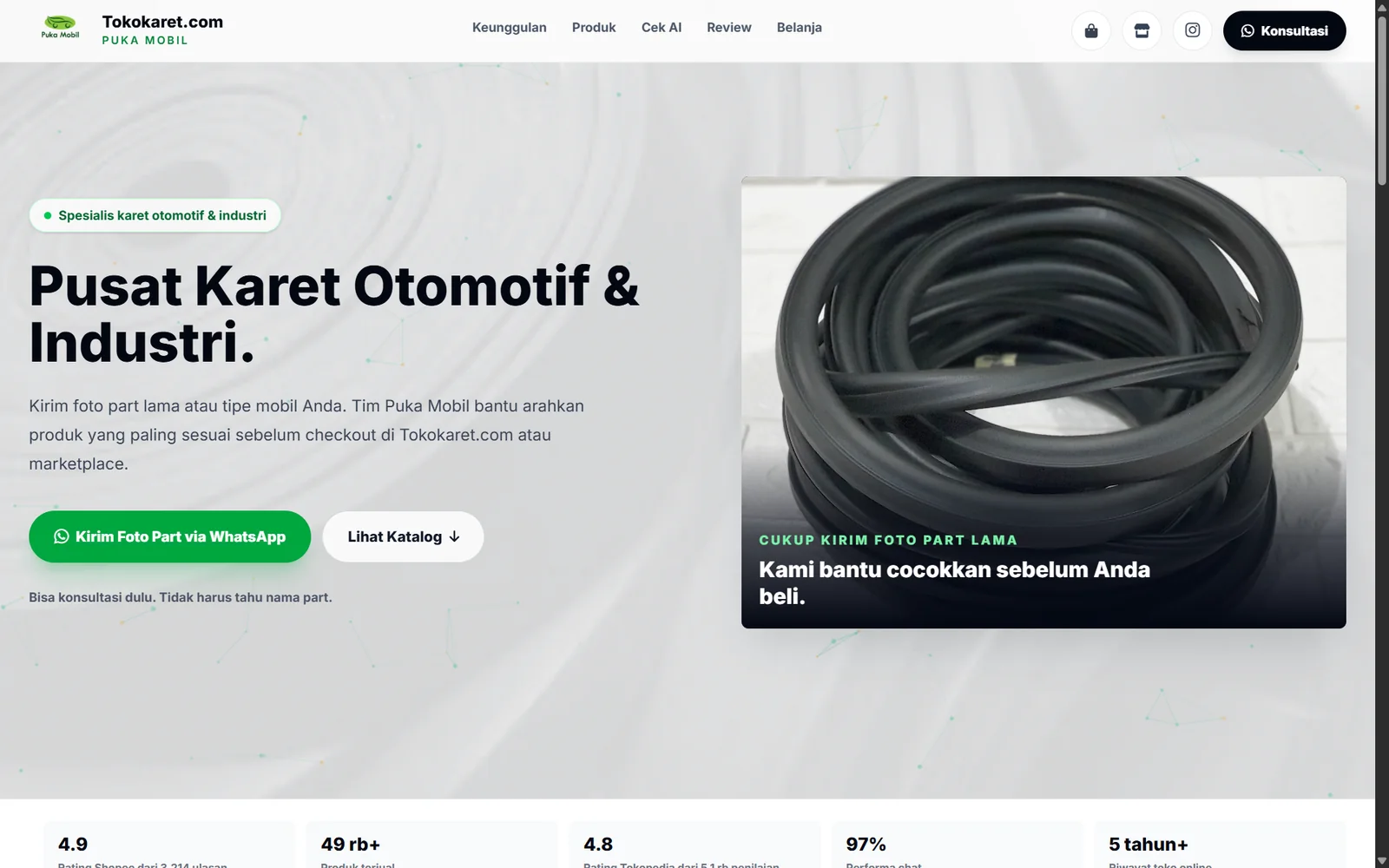
01 / 03 A live commerce platform for rubber and industrial products with a guided, symptom-based consultation flow.
The problem to solve.
TokoKaret.com is a live commerce platform bridging industrial product catalogs and informed purchase decisions. Its client-side symptom matcher gives an initial rubber-part category direction before human WhatsApp confirmation; it is not presented as a retrieval or model-backed AI system.
Problem
Industrial and rubber product buyers need guided product selection and consultation, but traditional e-commerce lacks the expertise to recommend products based on symptoms and use cases.
People
Industrial buyers, workshops, and businesses needing rubber and industrial products
The choices behind the interface.
Designed and built the landing experience, consultation journey, marketplace pathways, and client-side symptom-to-category recommendation helper.
- Translating technical industrial product specifications into accessible user-facing recommendations
- Constraining recommendations to product categories without overclaiming exact part compatibility
- Integrating guided recommendations with offline sales workflows
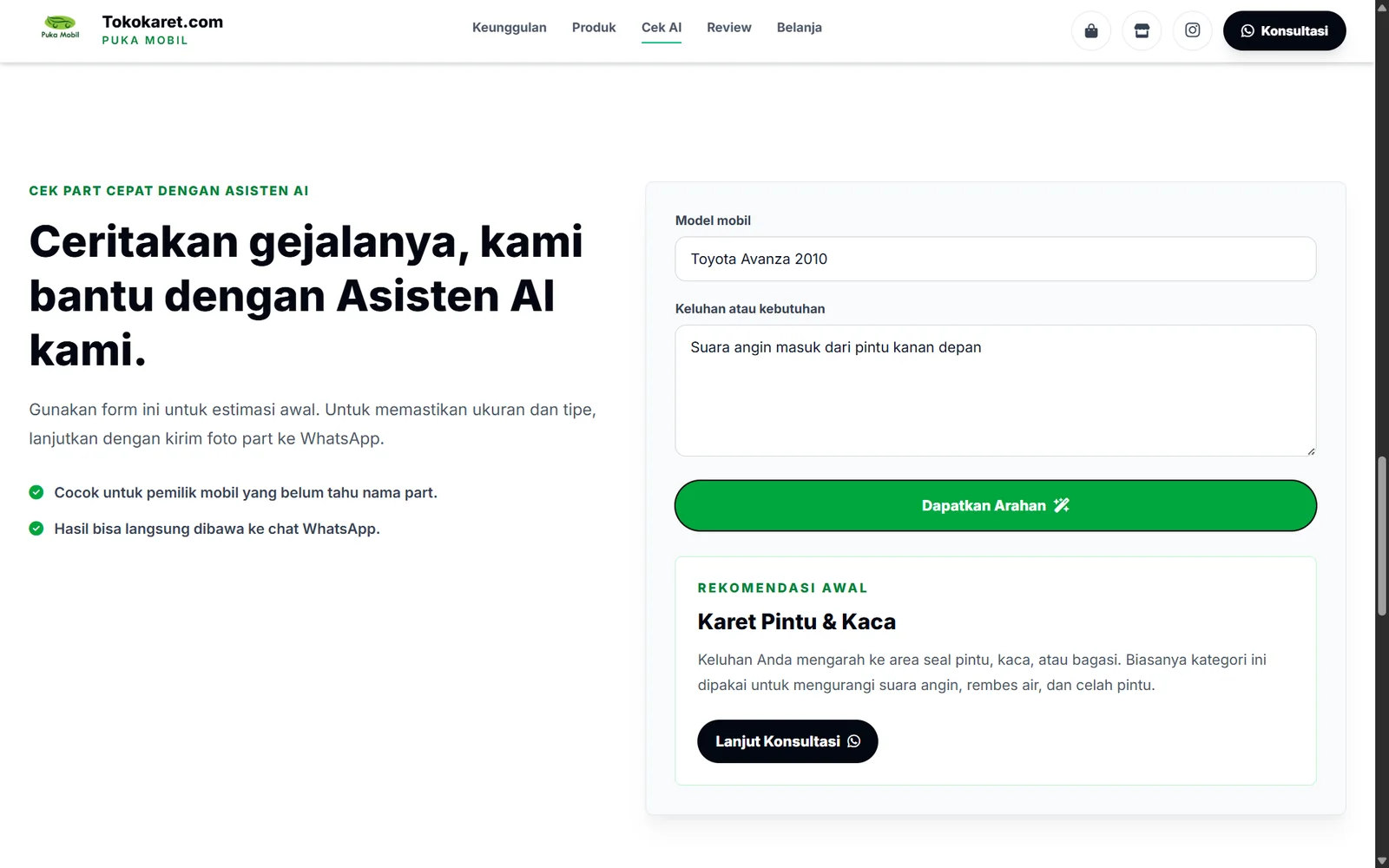
What I built.
Designed and built the landing experience, consultation journey, marketplace pathways, and client-side symptom-to-category recommendation helper.
- Built the live Astro storefront, product-first landing sections, consultation CTAs, and mobile-first buyer journey.
- Built the structured intake flow that maps car model and symptom keywords to a constrained product-category direction.
- Connected the guidance flow to WhatsApp so final compatibility confirmation still uses human review and photo evidence.
Explore the pipeline
01User enters car model plus complaint or use case in a structured form.
Form input stays in the client-side flow: model and symptom keywords guide a category suggestion and WhatsApp handoff.
02The browser matches the input against constrained symptom and category keywords.
The browser matches the input against constrained symptom and category keywords.
03The helper maps symptoms to likely product categories instead of claiming a guaranteed SKU match.
The helper maps symptoms to likely product categories instead of claiming a guaranteed SKU match.
04Sales follow-up uses the suggestion plus photo verification for final product matching.
The helper is intentionally positioned as initial guidance; final size/type confirmation happens through human consultation and photo evidence.
Results, with context.
Built for Puka Mobil, a marketplace seller that has served 4,000+ customers and sold approximately 50,000 items across Shopee and Tokopedia; website-attributed conversion remains unmeasured.
The storefront supports Puka Mobil, a marketplace seller that has served 4,000+ customers and sold approximately 50,000 items across Shopee and Tokopedia. These are business-history figures, not website-attributed results.
Under the hood.
Technologies & features +
Astro / TypeScript / Tailwind CSS / Rule-Based Recommendation
- Conversion-focused landing experience
- Client-side symptom-to-category recommendation helper
- WhatsApp and marketplace sales pathway integration
- Customer consultation journey with structured intake
- Responsive design optimized for mobile-first Indonesian users
AI system notes +
Provider / model
Client-side keyword and category matching; no active retrieval backend or model call is claimed.
Data flow
Form input stays in the client-side flow: model and symptom keywords guide a category suggestion and WhatsApp handoff.
Validation
The helper is intentionally positioned as initial guidance; final size/type confirmation happens through human consultation and photo evidence.
Failure handling
When no constrained match is available, the interface pushes the user to continue consultation rather than overclaiming a product fit.
Limitations
The keyword helper recommends categories, not guaranteed part compatibility. Physical photo confirmation remains necessary, and website-attributed conversion is not yet measured.